
This article is part of a series of inquiries using Quintaveran analysis™ that unearth interesting perspectives to inform executive decision-making.
Obesity messaging at a moment of fragile investor sentiment
At a time of fragile investor sentiment, a major global pharmaceutical company entering the obesity market is navigating a phase of strategically important Loss of Exclusivity (LOE) transition with limited immediate options for M&A, as its top-earning products face imminent patent expirations.
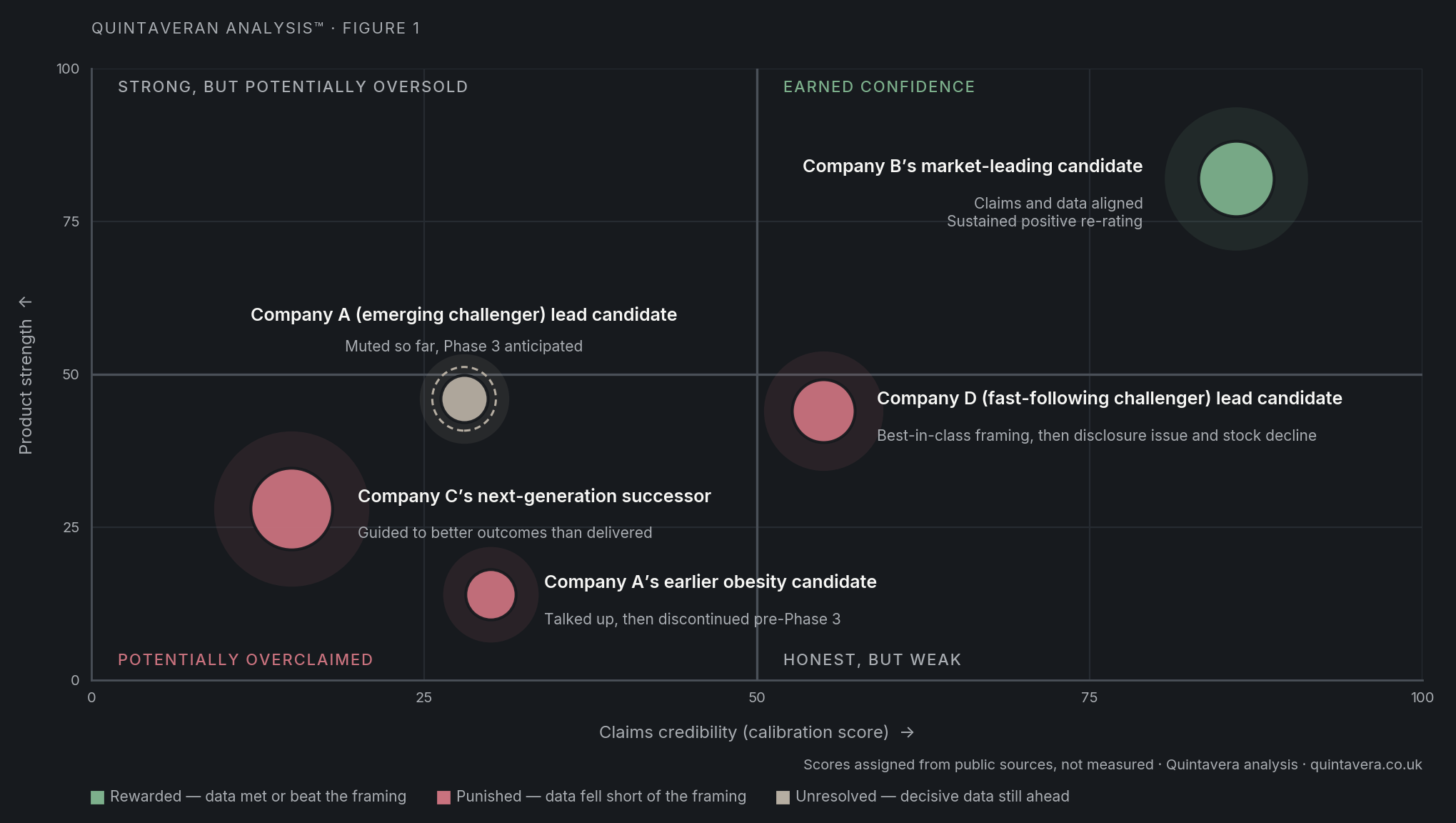
Quintavera explored the opportunities and risks associated with the company (Company A) using obesity product messaging to power corporate communications.
We considered whether obesity pipeline evidence, as it currently exists in the public domain, could be considered sufficiently compelling, differentiated and resilient to competitors for management to elevate obesity to a headline component of the company’s post-LOE growth narrative without creating disproportionate credibility or sentiment risk.
We tested the following assumptions…
H1a: Whether headline positioning produces a net strategic advantage, i.e. lifts investor sentiment, re-rates the stock ahead of LOE, and accelerates pipeline credibility more than it exposes Company A to downside if trial or competitive results disappoint.
H1b: Whether headline positioning produces net harm, i.e. sets an expectations bar that clinical data, regulatory timelines, or competitive dynamics (incumbent incretins, oral candidates, etc.) are unlikely to clear, so the credibility and stock-reaction risk of under-delivery outweighs any signalling benefit.
The Quintaveran method
To test the two alternative hypotheses (H1a and H1b) we looked at the evidence from several angles and combined them in a scorecard:
- We built a standardised scoring system to analyse media coverage and transcript text, mapping against clear, real-world indicators for each prediction.
- We ran a mini event study to isolate and track how stock prices and trading volumes changed immediately following specific corporate events.
- We benchmarked our findings against past historical precedent to see how these cases compared.
- We monitored how much financial analysts disagreed with one another (analyst estimate dispersion) to gauge overall market certainty and credibility.
- Finally, we aggregated all these complex metrics into a simple scorecard to clearly compare the outcomes and validate our core assumptions (see above).
What we found
On the basis of our analysis, over-indexing on obesity messaging in current corporate communications leans towards a net expectation/credibility risk for Company A, with a caveat that this could flip once more Phase 3 obesity data lands.
This assessment is based on the lead obesity candidate’s Phase 2b results being perceived as ‘real but middling’ vs competitors: weight loss depending on dose (10–16%) trailed the market-leading incretin (~21%) and was well behind the leader’s next-generation candidate (~28%), with a significant double-digit discontinuation rate in monthly-dose arms driven by GI tolerability.